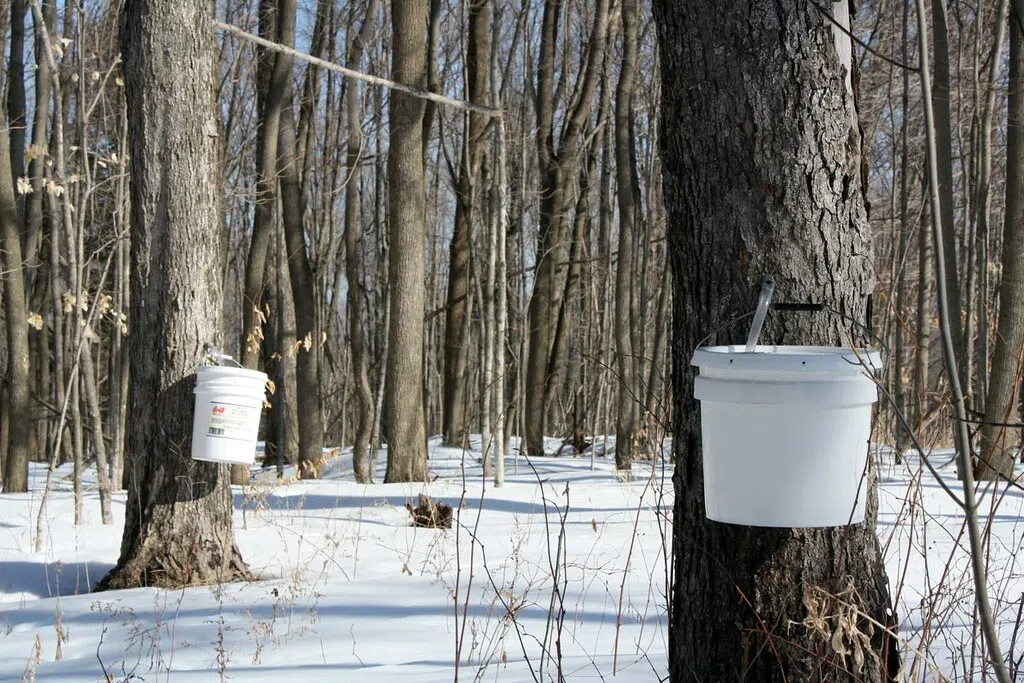
Jason Dean / CC
There are few commodities more Canadian than maple syrup—and fewer still that are more pervasive originating from Canada worldwide.
Statistics Canada says that last year, nearly $80.4 million in worldwide maple syrup sales was generated here in Canada.
Ray Bonenberg is a Sugar Maker with Mapleside Sugar Bush.
He is also on the board of directors for the Ontario Maple Syrup Producers Association, as well as a member of the International Maple Syrup Institute.
Bonenberg’s position makes him one of the leading authorities on the Canadian “liquid gold”, and he says these are far from low-level dealings.
Among the many projects Bonenberg has his hands in is a recent climate change initiative studying just how “earth-friendly” maple producers really are.
Bonenberg also sits on a marketing board that deals with interests pertaining to the worldwide distribution of maple syrup, which, according to him, is a massive economic concern for Canada.
Among the many world markets where maple syrup is consumed, Japan sets the bar for consumption throughout Asia.
Japan is a world leader in quality, and when Japan says it’s good—Asia agrees.
With maple syrup being produced almost entirely in Quebec, our French-speaking provincial neighbours understand that it’s better to distribute the product under the Canadian flag rather than the fleur-de-lis.
Bonenberg says it’s a bit too early to tell what this season is going to look like, but the well-above-average snowfall in the Valley this winter—as well as in other parts of the province, including Quebec—means the season will be later than usual.
This does not necessarily mean that the overall annual amount produced will be affected. Maple trees are subject to Mother Nature’s will and will respond accordingly, says Bonenberg.
Most of the syrup from Ontario and Quebec will be produced in April, says Bonenberg, including in areas south of Highway 7, which are influenced by weather patterns created by the Great Lakes.
This has been a particularly tough winter and will continue to present a challenge to producers well into next month.
Bonenberg expects that the yield this year will be comparable to most previous years, which means that the cost of the product at checkout should remain fairly stable.
(Written By: Richard Evans)
