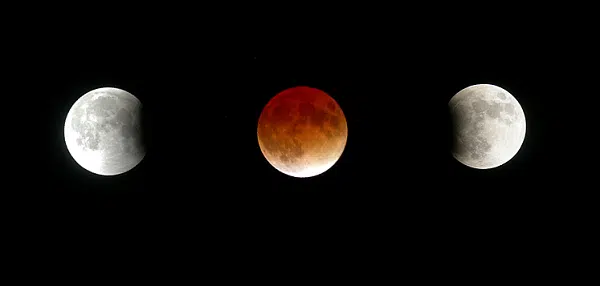
Courtesy of Gary Boyle
Early risers across Canada will have a front-row seat to a stunning celestial event on the morning of March 3, as a total lunar eclipse unfolds across much of the country.
That was Backyard Astronomer Gary Boyle.
The eclipse will be visible in its entirety from the Pacific and Mountain time zones,while we will only be able to see a part of the show before the moon sets.
A lunar eclipse occurs when the Earth moves directly between the sun and the moon, causing Earth’s shadow to fall across the lunar surface.
With no need for telescopes or filters, Boyle encourages people to simply step outside, find a clear view of the sky, and take a few moments to watch the slow transformation of the moon.
It is something that can be captured on camera, but Boyle recommends taking it in with your eyes.
While weather conditions will ultimately determine visibility, the timing of the eclipse varies by region, with western Canada seeing the full event and eastern regions catching partial phases before moonset.
Eclipse Timing by Region (Local Times)
Newfoundland & Labrador
Eclipse begins: 6:20 a.m.
Moonset: 6:35 a.m.
Atlantic Canada
Eclipse begins: 5:50 a.m.
Moonset before totality: 7:00 a.m.
Eastern Canada (Ontario/Quebec)
Eclipse begins: 4:50 a.m.
Mid-eclipse: 6:33 a.m.
Moonset: 6:39 a.m.
Central Canada (Manitoba)
Eclipse begins: 3:50 a.m.
Mid-eclipse: 5:33 a.m.
Moonset: 7:10 a.m.
Mountain Time Zone
Eclipse begins: 2:50 a.m.
Mid-eclipse: 4:33 a.m.
Eclipse ends: 6:17 a.m.
Pacific Time Zone
Eclipse begins: 1:50 a.m.
Mid-eclipse: 3:33 a.m.
Eclipse ends: 5:17 a.m.
For those able to see the full eclipse, the most dramatic moment will be around mid-eclipse, when the moon is completely immersed in Earth’s shadow and glows a deep copper or orange colour.